The average life expectancy in the U.S. is 79, according to the Centers for Disease Control and Prevention, but that average ranges drastically — from the mid-50s to the mid-90s — based on where people live. A new model called the “universal basic neighborhood” aims to help people in all communities maintain an average life expectancy of at least 80 by spreading health across neighborhoods rather than concentrating it in a few pockets.
“Part of the problem we have in many U.S. cities is that we have really, really well-to-do, wealthy neighborhoods with an incredible amount of [health-related] assets, but it doesn’t translate into massive gains in life expectancy,” said Michael Emerson, a fellow in religion and policy at Rice University who led the UBN study.
Concentrating health-care resources in those wealthy neighborhoods to increase life expectancy by a couple of years is “a waste of resources” that would be better spent on interventions to boost life expectancy in other places, he said.
UBN focuses on “the basic neighborhood — not the most advanced or wealthiest neighborhoods” — for maximum impact on public health, he said. “More meaningful insights emerge when neighborhoods are evaluated in relation to their own potential,” according to a report introducing the model. “This approach shifts the focus from relative comparison to aspirational benchmarking, using a combination of health-supporting goals, regional and national targets, and community-informed values.”
Emerson and researchers at the University of Louisville and Simmons College of Kentucky define a UBN as “the minimally acceptable mix of neighborhood health assets for residents to flourish in quality and length of life.” To determine those assets, they identified 35 metrics across four domains: environmental, housing, social and transportation.
Those metrics include average maximum temperatures during the warm season, affordable housing, internet access and proximity to acute care hospitals. For each, the researchers used a standard (e.g., a mean daily maximum temperature of less than 88 degrees from May to September) and a threshold score.
“Cities perform a whole lot better when they spread the health across the city, rather than have it concentrated in just a few places,” Emerson said, citing benefits including lower crime, stronger relationships and greater civic engagement. “It’s hard to see what the downside would be.”
A tale of two neighborhoods
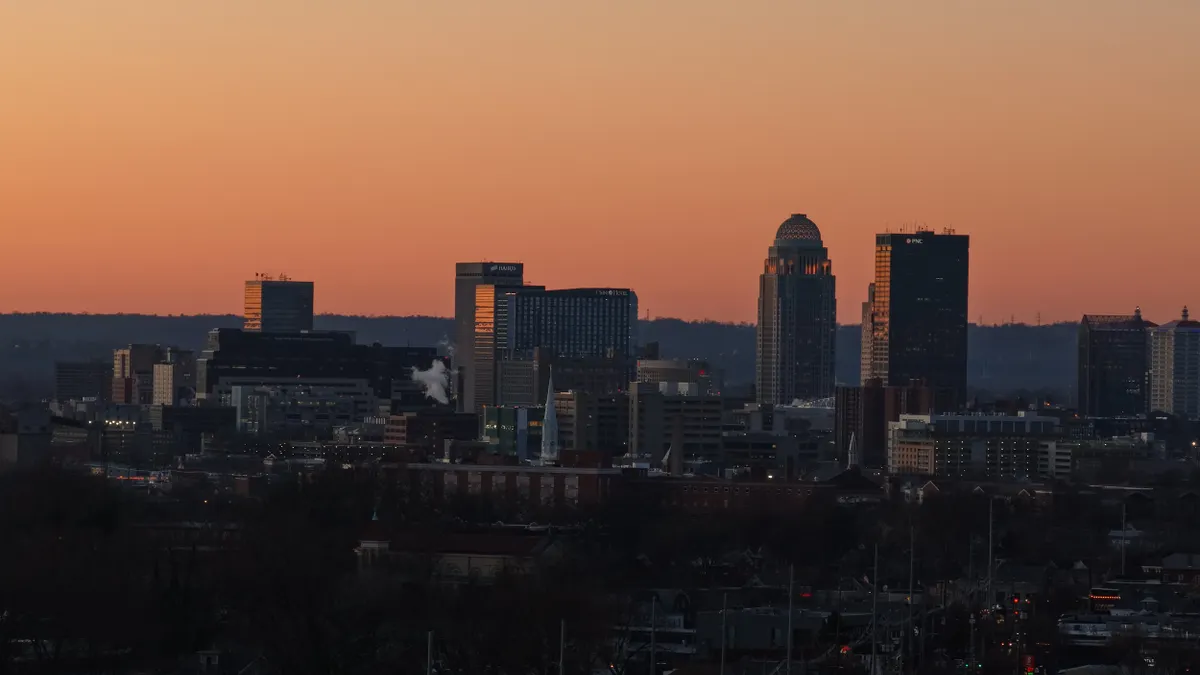
The researchers applied the UBN concept to two Louisville neighborhoods, Crescent Hill and Russell, using publicly available data, resident surveys, focus groups and assessments of neighborhood plans for growth and development.
They found that Crescent Hill qualifies as a UBN. It has a life expectancy at birth of 81, 19 health-supporting assets and five liabilities. By comparison, Russell has a life expectancy at birth of 65 and 10 assets and 21 liabilities.
“That’s a huge gap,” Emerson said. “In Russell, you work, and as you're about to retire, you die, on average. In Crescent Hill you work, you retire and then you have 15 or more years to spend time with grandchildren, to travel, to do bucket-list things, to spend time with friends and family.”
With clearer insight into their specific strengths and gaps, the neighborhoods can target interventions, Emerson said. Russell resident Jecorey Arthur, one of the report’s authors and a professor at Simmons, is using the report’s data in his work to reduce senior loneliness and help people at risk of losing their homes.

Arthur emphasized the importance of including residents alongside academic researchers and government officials in such work. “Somebody might be an expert in planning, somebody might be an expert in how to conduct research. Me and my neighbors are experts in living in the Russell neighborhood, and our experiences are just as much an expertise,” he said.
Even qualifying neighborhoods can be fragile, said Crescent Hill Community Council President Erin Michalik Klarer, who was part of the report’s research team. “Even though it is a well-educated, affluent neighborhood, we still have a food pantry and we are still very much affected by triggers in the economy that are happening now, like gas prices and the food shortage,” she said.
Ultimately, residents in both neighborhoods have the same priorities, Michalik Klarer added. “A lot of the answers to our survey questions were almost identical between Crescent Hill and in Russell — the same desire for safety, the same things that were of concern.”
Expanding the model
The UBN model is designed to help neighborhoods across the U.S. It includes a policy document that states could adopt to launch UBN assessments, potentially requiring participation across localities. “The state will give this overall ‘here’s what has to happen,’ but it leaves the flexibility for every municipality to work with each neighborhood to provide what they need,” Emerson said.
State involvement isn’t a requirement. Last week, representatives from Dallas were the first from outside Louisville to contact Emerson for guidance on conducting a city-level assessment there, he said.
The framework is designed to evolve as more communities participate, Emerson said. “We’re learning on the ground” through successful interventions in Russell and Crescent Hill, he said. The team will continue to revise the framework “to make it easier to do and more effective.”