

The last few years have seen a wave of AI products entering the public sector.
Samsara, an artificial intelligence and technology service provider, is among the companies expanding their municipal footprint. The company offers AI tools for local governments that range from fleet management to asset tracking to pothole detection — with promises of more customized offerings on the way. The company says it currently works with hundreds of cities.
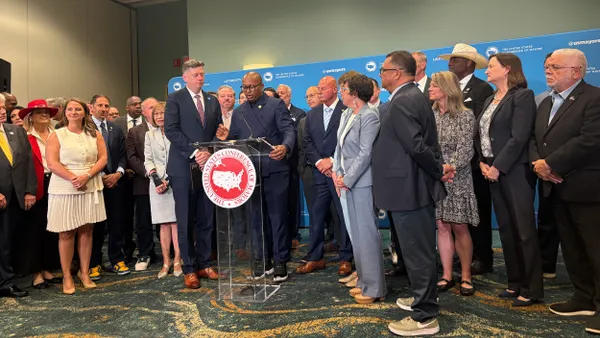
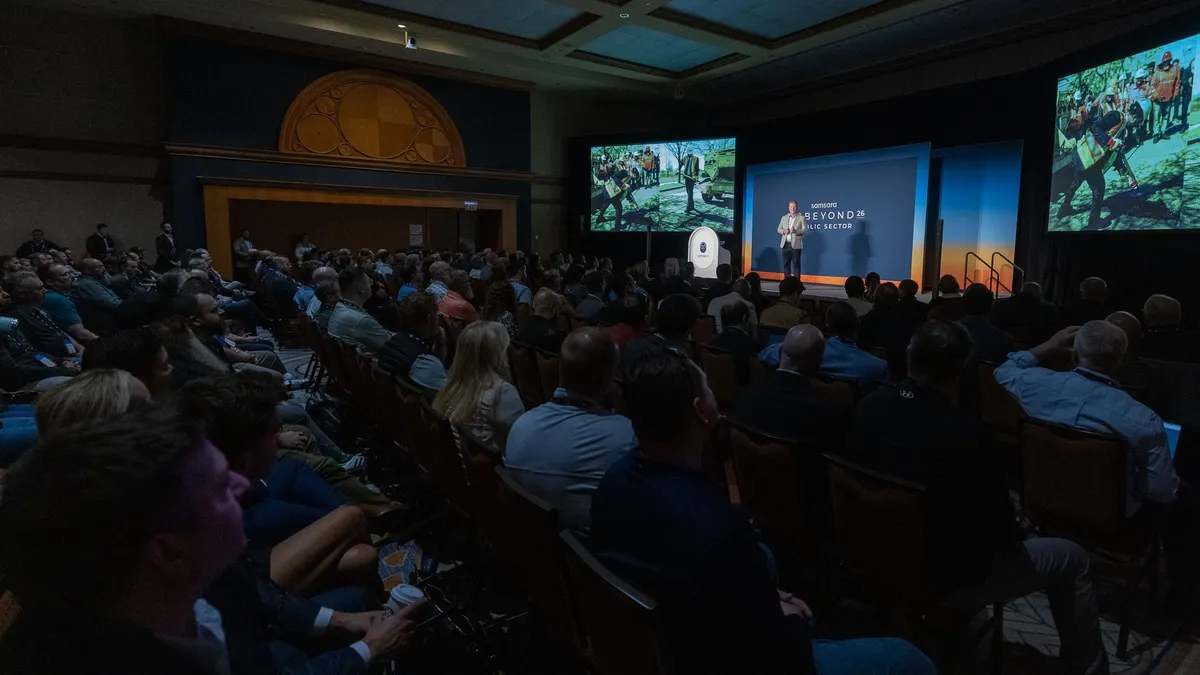
Samsara last month hosted its first conference in Chicago catered exclusively to the public sector, complete with demonstrations, workshops and listening sessions with local government officials from across the country.
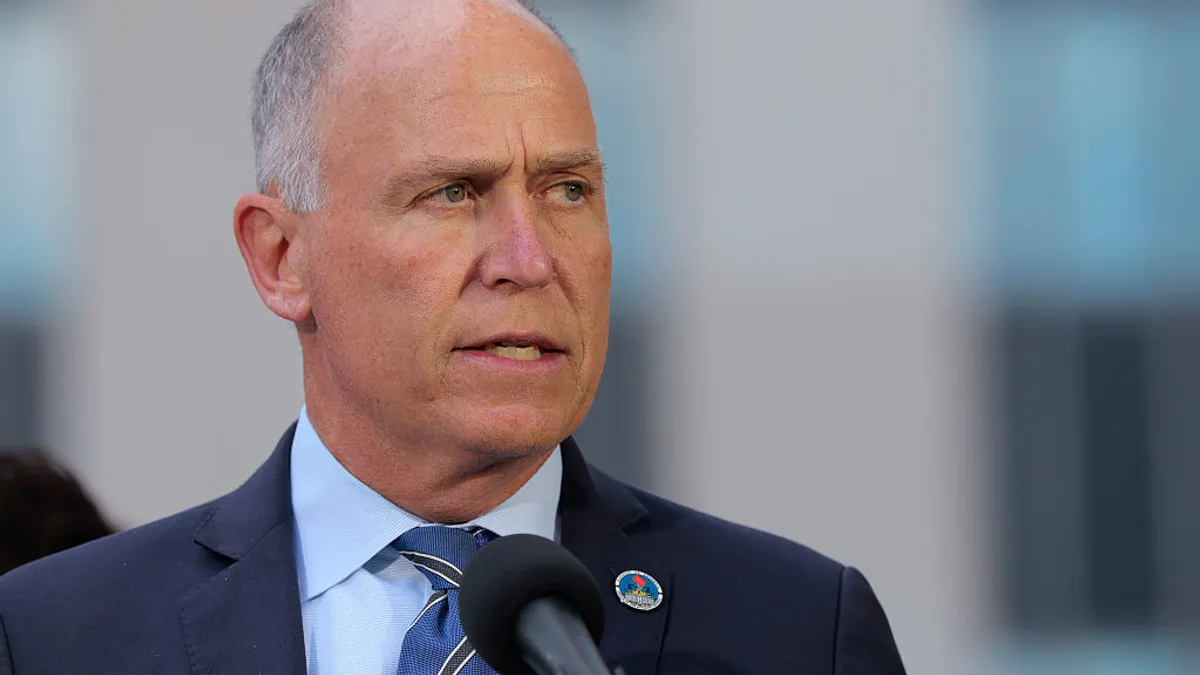
Smart Cities Dive sat down with Samsara Senior Vice President for Sales Engineering Tim Nagy to talk about AI adoption in local government, and what the future of AI in cities could look like.
The following interview has been edited for brevity and clarity.

Smart Cities Dive: What is it about the public sector that made you decide to expand your AI product offerings there?
TIM NAGY: The public sector is, I feel, very underserved by the physical operations technology space, and there is a lot of opportunity for us to partner together and improve operations out in that space.
It's such an interesting mix, because in the room today [at Samsara’s Go Beyond Public Sector conference in Chicago May 12], there's no competition; everyone in there is just wanting to brainstorm about ideas and talk with each other and figure out best practices, and that's an interesting dynamic. And it means that, more than in the private sector, we're able to share in groups with people and get a group consensus or feedback, rather than the private sector, where that's a bit harder and people don't want to share trade secrets. And so we started realizing that AI could really take the grunt work out of a lot of what public sector employees are working hard at today.
In your view, what is the most challenging part of AI adoption for a local government?
It’s not just in the public sector, but there is a hesitation or reticence to know about the perceived negative things that are happening in the community, like a pothole. And the concern is, if we know about the pothole, are we liable for the pothole? And so I think that is an impediment to rolling this technology out faster. We now can detect potholes with AI. And we can display these on a map for you. Do you want to see those, is a good question. And we will no doubt figure this out in the next few years as citizens of America, but in the meantime, I do think it's an impediment to adoption.
Is that a resource issue that local governments are talking about when it comes to identifying potholes?
There is a resource concern because they are worried that if they identify potholes, there are going to be more potholes than they have people to fill them, so there is a resource concern there, in addition to the liability one as well.
What are you hearing from cities about their biggest needs right now from AI?
I would categorize the needs into two different buckets: one is reducing risk to their employees, and the other is increasing efficiency of city operations.
Reducing risk looks like implementing an incident center where you have an urgent situation that needs your attention in one centralized dashboard. Increasing efficiency comes in many forms: one use case from Kalamazoo [County, Michigan], where they've reduced their city salting street operation just by knowing where they had been with those trucks.
What are the main security and privacy risks of adopting AI in local government, and what are some of the guardrails that you offer?
I think many of the concerns around AI are really with large language models, where you're potentially putting a lot of personal or corporate or public-sector city information onto a large language model that eventually could become part of that model or maybe even be seen by other people.
The products that we have are a little bit different in that the information is always contained within the Samsara dashboard and within just the local government's own dashboard, so it's not getting sent out. It's owned and contained by Samsara. There are other privacy concerns around the use of AI that I think we will be learning and talking about more as an industry coming up. For example, we launched Street Sense for ground intelligence today. Those pictures and images gathered by vehicles in the Samsara fleet have been anonymized by AI, so that there's no identifying information on those pictures.
I think AI is going to make a lot more possible with regards to protecting privacy as we release more products. We also blur the operator names, we can blur faces with AI, we can blur any identifying piece of information almost using AI in the system. … It's a feature in the dashboard where you can literally click “enable facial blurring.” And you can even blur passengers in the vehicle as well. And that's totally configurable and done automatically by the dashboard.
What do you think is the biggest misconception the public sector has about AI products right now?
The most common misconception is that AI is not ready to help, which is now definitely not true. There's some distrust of the new technology in pockets, but the AI that we see today is very different from the AI that we saw a year ago. In the last two years, AI large language models have gone from an average IQ of about 100 to some that are 130 or higher. And so I think for anyone who has hesitated to investigate how AI can help them with their local government operation, it's time to take another look.
What do you think AI in local government looks like a year from now?
I think it's surprising, even for us in the industry, how quickly AI is moving. A year from now, we'll be using AI to detect even more things. We can see these are potentially possible in the next year: detecting clogged drains, looking for graffiti in the city, looking for downed street signs. All of these are AI-driven detections that could be possible in the next year, and there are many other ways that AI can drive efficiency.
We talked about how teams can know immediately when there's an incident, and not finding out about it three hours after the fact. That's going to continue to improve, and we also have recently integrated weather information directly into our dashboard. We'll continue to see AI-based improvements there. We've just released weather speed recommendations so once it starts raining or snowing, we advise drivers to lower their speed, and we set a new state speed limit. We will continue to see improvements in reducing risk for drivers using AI. We can already detect impending pedestrian collisions around a vehicle, even on the sides.