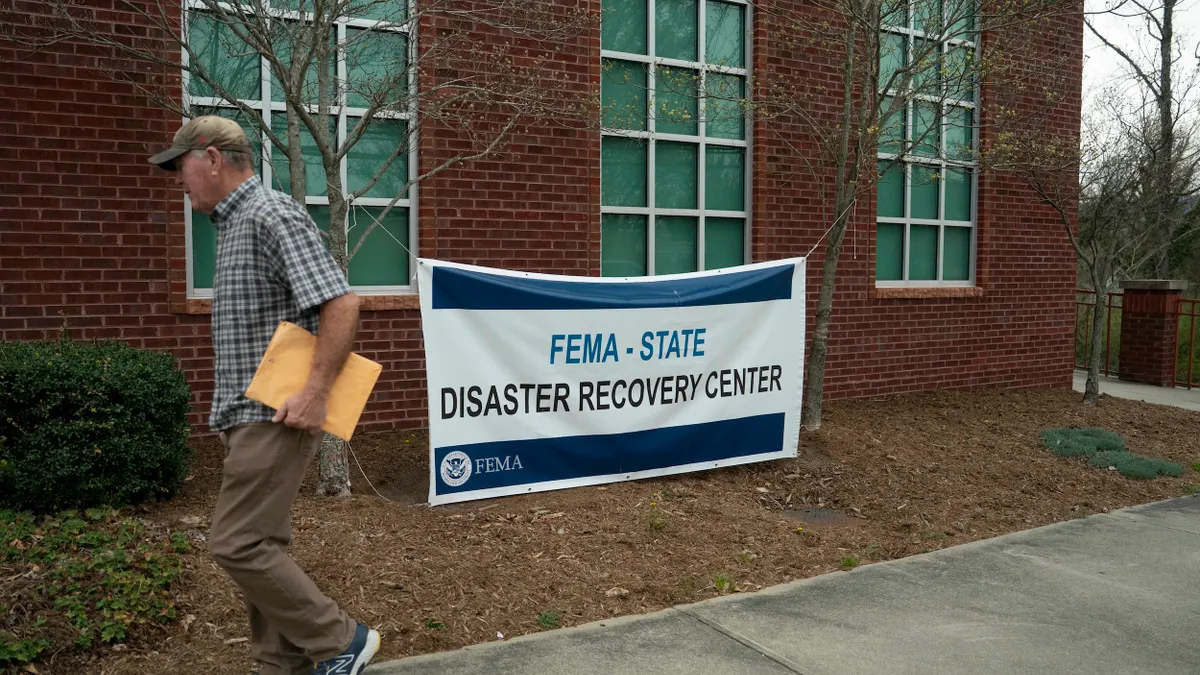
The Federal Emergency Management Agency is making $1 billion in federal funding available for states and local governments to protect their communities from natural disasters. Applications for fiscal year 2024-2025 grants from the Building Resilient Infrastructure and Communities program are due July 23. The notice of funding opportunities comes after a judge ruled in March that FEMA had to reverse its termination of the $4.5 billion BRIC program.
FEMA said in a press release that the BRIC program has “a renewed focus on infrastructure-related hazard mitigation projects and empowering state and local leaders.” BRIC’s new focus is designed to fund construction projects that are ready to implement. It incentivizes communities to adopt the latest hazard-resistant building codes and eliminate phased projects. It also shifts responsibility and authority to states “by removing funding for hazard mitigation planning and non-financial direct technical assistance provisions,” FEMA said.
ICF, a consulting and technology firm that helps state and local governments with grant application development, broke down what that means during a webinar Friday.
FEMA funds projects in two primary categories, said Rachel Bradley, director of strategic resilience for ICF. The capacity and capability-building category is for projects that directly support infrastructure resilience — things like building codes and code adoption enforcement activities and technical training. In the hazard mitigation category, it funds construction and infrastructure projects that reduce loss of life, property damage and disruption of critical systems.
FEMA defines infrastructure as transportation, utilities, communications, public buildings and other critical facilities, so projects should reduce risk to those entities to qualify for grants, Bradley said. Projects should have a conceptual design at the very least, and proposals should show a clear path to implementation. Costs for things like administering the grant and managing scope, schedule and budget can be included, but they can’t be more than 5% of the total project cost, she explained.
“BRIC is an all-hazards program, so really be thinking across all of your natural hazards,” Bradley said. Funding could be applied to “flood protection and retrofits, acquisitions, elevations, relocations, microgrids, backup and emergency power, building code initiatives, utility hardening, [and] wildfire mitigation,” among other projects, she said.
“Tell a tight and consistent story”
Evaluation criteria in the relaunched BRIC program are tighter than before, Bradley said, and FEMA is signaling that it is prioritizing implementation-ready infrastructure projects — “not concepts, not planning, not phased.” Success depends on project readiness, alignment with the notice of funding opportunity and demonstrated risk reduction, she said.
“Communities that can clearly define the problem and show a credible engineering solution and prove that a project can move to construction within the period of performance is a really huge factor,” Bradley said.
Benefit-cost analyses are pivotal, she said. “Cost effectiveness is an eligibility criteria, so applicants can really add value by encouraging early BCAs.”
“A strong BCA isn't just a math exercise, it tells a clear story about losses avoided and community benefits,” said Jennifer Davis, senior manager, strategic resilience, for ICF. “Starting the BCA early and aligning it closely with the project scope is one of the best ways to strengthen a BRIC application.”
BRIC funds projects that are “appropriately scoped,” she added. They should not be overly ambitious but “large enough to demonstrate meaningful risk reduction.”
“It’s really, really important to tell a tight and consistent story,” she said. In addition to aligning applications directly with FEMA's NOFO language and terminology and quantifying risk reduction through a well-documented BCA, communities must demonstrate organizational readiness with a solid implementation plan and a proven track record of managing infrastructure projects, Bradley advised.
“When we say [to submit a] complete application, we mean more than a good idea,” Davis said. A detailed scope of work must align with a line-item budget that includes separately listed pre-award and management costs; a go/no-go milestone schedule; a hazard history drawn from state and local plans and FEMA records; National Environmental Policy Act documentation, including flood plain and wetland maps; and maintenance planning, she said. Document building code adoption and enforcement for “up-to-date hazard-resistant building codes” like the International Building Code and any higher local standards that address specific hazards in the area, Davis added.
“This cycle is more competitive and more focused on construction-ready resilience infrastructure,” Davis said. “New applicants and sub-applicants have an edge when they pair mature designs with clear delivery plans. Building codes and compliance continue to matter as a priority because the criteria are streamlined. Ensure your strongest claims are well documented.”