Within Lawrence, Indiana, a city of about 50,000 near Indianapolis, a short drive from one ZIP code to another registers an eight-year drop in life expectancy, according to a 2025 Indiana University School of Public Health report.
In response to that report, which mapped life-expectancy disparities throughout the metro Indianapolis area, Lawrence adopted the motto “live longer in Lawrence.” Dr. John Kunzer, the city’s first-ever chief medical officer, said in a statement that “by addressing the root causes of health disparities, expanding access to care, promoting mental wellness, and encouraging active, connected lifestyles, we’re building a healthier future for every resident.”
Lawrence was one of six cities chosen to participate in the National League of Cities’ Cities of Opportunity Community Health and Well-being Accelerator, a year-long program that helps cities design comprehensive plans to address root causes of health disparities. Perris, California; Commerce City, Colorado; Miramar, Florida; Providence, Rhode Island; and Las Vegas are also in the cohort.
“We selected cities that were poised to engage with this process,” Georgia Gempler, NLC program manager, health and wellbeing, told Smart Cities Dive. “Lawrence’s campaign was already started, and we’ve worked with them to build it out.”
The accelerator offers coaching and project-based learning, but perhaps the most valuable aspect is the peer-to-peer connection, Gempler said. The cities are learning from one another about how to look “at all policies across the board — city planning and design, health and human service, economic opportunity” — to develop cross-departmental solutions, she said.
Through an executive leadership track, mayors, city managers and other executive-level leaders from participating cities can engage in accelerator programming alongside their city staff. Most of the collaboration takes place virtually, and there is an in-person gathering, she added.
Turning data into action
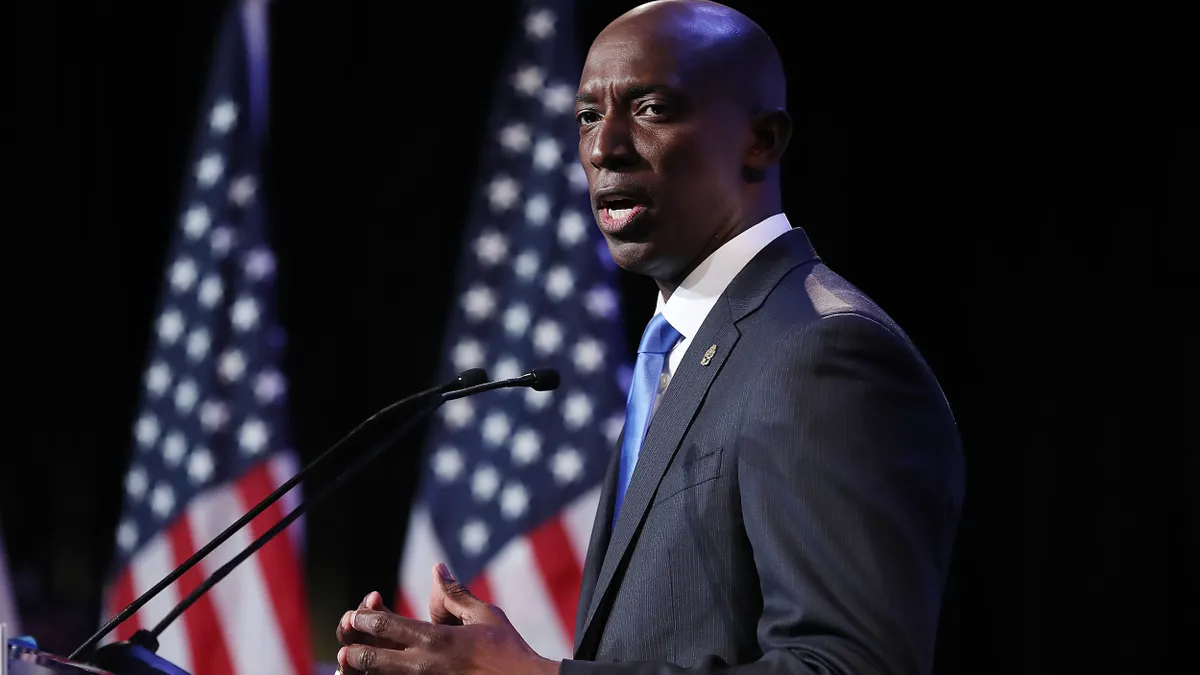
Miramar Mayor Wayne Messam said he finds that when people think about health inequity, “they think about hospitals and doctors.” But health disparities — avoidable differences in healthiness across the population — stem from a welter of other problems, including inadequate housing, unsafe environmental conditions and lack of access to transportation and social services.
With the help of NLC staff, Messam said the six cities have shared information to address these obstacles.
Phase one of Miramar’s project was a comprehensive assessment, he said. In phase two, “we’re validating our findings with surveys and focus groups.” Next, the plan is to “turn data into action” by identifying priorities and aligning resources to fight the disparities. “We’re taking a citywide approach to health,” he said.
Messam said he is already seeing stronger partnerships within the city of 144,000. For example, to ensure “an autism-friendly city,” efforts are underway to expand communications tools, increase community awareness and provide training for staff and local businesses.
Messam also wants to make sure the plan sufficiently supports seniors, “one of [the] fastest growing groups” in the community.
With the help of the accelerator, Perris — a city of about 84,000 in Southern California— is cataloging resources and “creating a concrete framework” for better health all around, said Emmanuel Marquez, the city’s public health supervisor.
One important area Perris is addressing is “infrastructure mobility” to accommodate people who need better access to housing and transportation, Marquez said. The city also plans to encourage the convergence of arts, culture and health and is exploring partnerships with local artists and local vendors to lead programs in parks, schools and community centers, he said.
A city proclamation states that participating in the arts promotes mental wellness and contributes to “increased longevity, overall well-being and fostering a healthier community.”
Learning from each other
Las Vegas, with a population of about 68,000, is the largest city in the cohort. There, the focus has been on Ward 3, where about 64% of the population is Latino, said Jace Radke, a spokesperson for the city.
The city has brought in several community partners, including Research, Education and Access to Community Health and the University Medical Center, a nonprofit public hospital. It found that lack of effective communication has been a barrier to good health and that information must be provided in Spanish to this community, Radke said. The next step will be to incorporate the work of the year-long project into the city’s neighborhood revitalization strategy plan for Ward 3, he said.
Becky O'Meara, also an NLC program manager, health and wellbeing, said the cohort model helps bring about systemic change. “Cities enjoy learning from each other, and cities of all sizes can relate to each other. They bring different strengths. That’s the secret sauce — big cities can learn from small cities, and small cities can learn from big ones,” O'Meara said.