

Dive Brief:
- A civil rights lawsuit filed against Berkeley, California, over the city’s encampment removal procedures was certified as a class action last week by a district court judge in the Northern District of California.
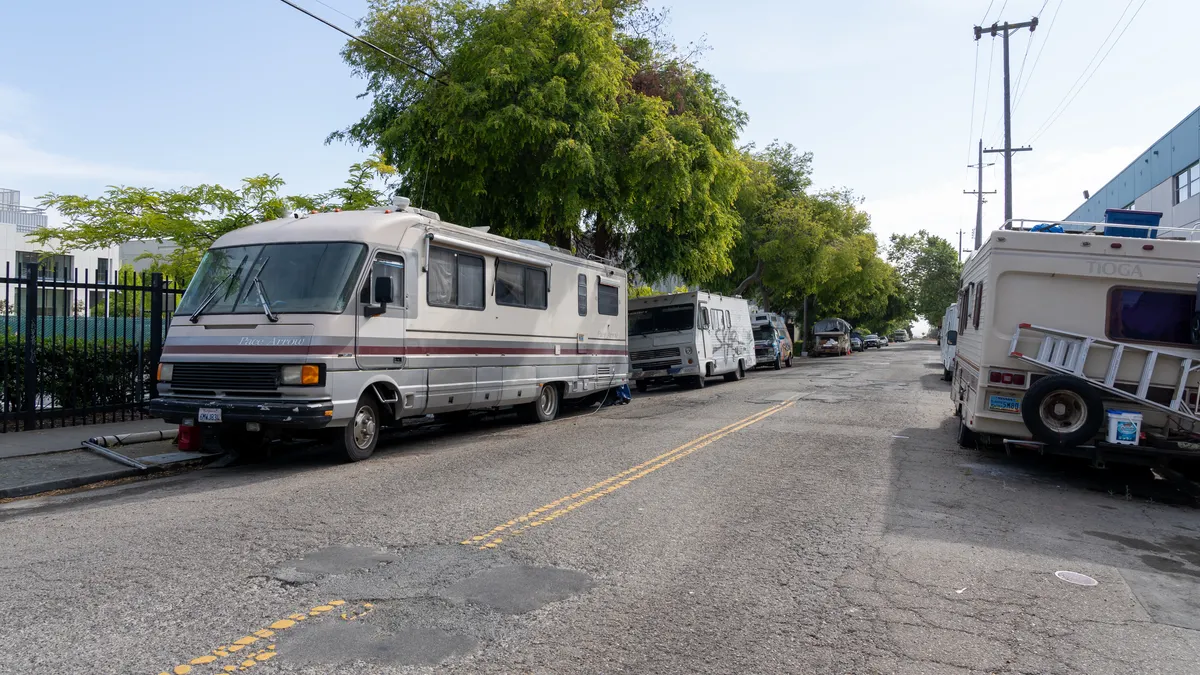
- The plaintiffs argue the city’s encampment removals violated constitutional protections against property seizure and destruction, and that the city’s 72-hour parking restrictions discriminate under the Americans with Disabilities Act.
- The city updated its encampment policy in 2024 to authorize removals when an offer of shelter “is not practicable” under “relatively narrow” circumstances, including when encampments pose imminent health hazards, fire risks or constitute a public nuisance.
Dive Insight:
A 2024 Supreme Court ruling granted local governments the authority to place bans on homeless encampments, and enforcement policies around the country are being shaped.
California Gov. Gavin Newsom has urged localities to adopt encampment bans on public land while stressing compassion and dignity.
A memo following the adoption of Berkeley’s 2024 encampment policy update affirms the city’s primary “housing-first” approach to homelessness and that it is a “care first, jails last” jurisdiction. “Staff view Berkeley’s new encampment policy as part of our broader commitment to creating safe, healthy, and compassionate communities,” the 2024 memo from City Manager Paul Buddenhagen states. “We will continue to prioritize a housing-first approach while addressing the immediate safety risks posed by encampments.”
Advocacy groups have pushed back on encampment removal enforcements — not always successfully. In April, U.S. District Judge Edward Chen ruled largely in favor of Berkeley in a separate but similar suit, allowing the city to continue encampment removals without a mandate to secure shelter or provide city-sanctioned campsites, Courthouse News Service reported.
The pending class action, filed by the by Disability Rights Advocates and East Bay Community Law Center on behalf of plaintiffs and the non-profit unhoused advocacy organization Where Do We Go, argues that the city discriminates against unhoused people with disabilities by failing to provide reasonable accommodation, and unlawfully destroys potentially life-saving belongings of the unhoused people it removes.
“The record contains abundant — and troubling — anecdotal evidence of an enforcement framework weighted in favor of property disposal,” U.S. District Judge Edward Chen wrote in his July 14 ruling. “These facts help illustrate both the breadth of the risk faced by the class, and the severity of the actual harms arising from the City’s challenged property seizure and destruction framework.”
California, the nation’s largest state, had the highest population of people experiencing homelessness in 2025 with 181,934. It recorded a nearly 3% decline in overall homelessness compared with 2024.