The twin cities of Minneapolis and St. Paul, Minnesota, set an ambitious goal to reduce both vehicle congestion and vehicle emissions in 2017. Their plan was to get 50,000 cars off the road in the next 10 years by emphasizing transit, bikes, vanpools and car-sharing. EV Spot Network, the electric vehicle car-sharing and public charging program the communities launched in 2022 as part of that effort, is a winner of the 2026 Smart Cities Dive Community Project Award.
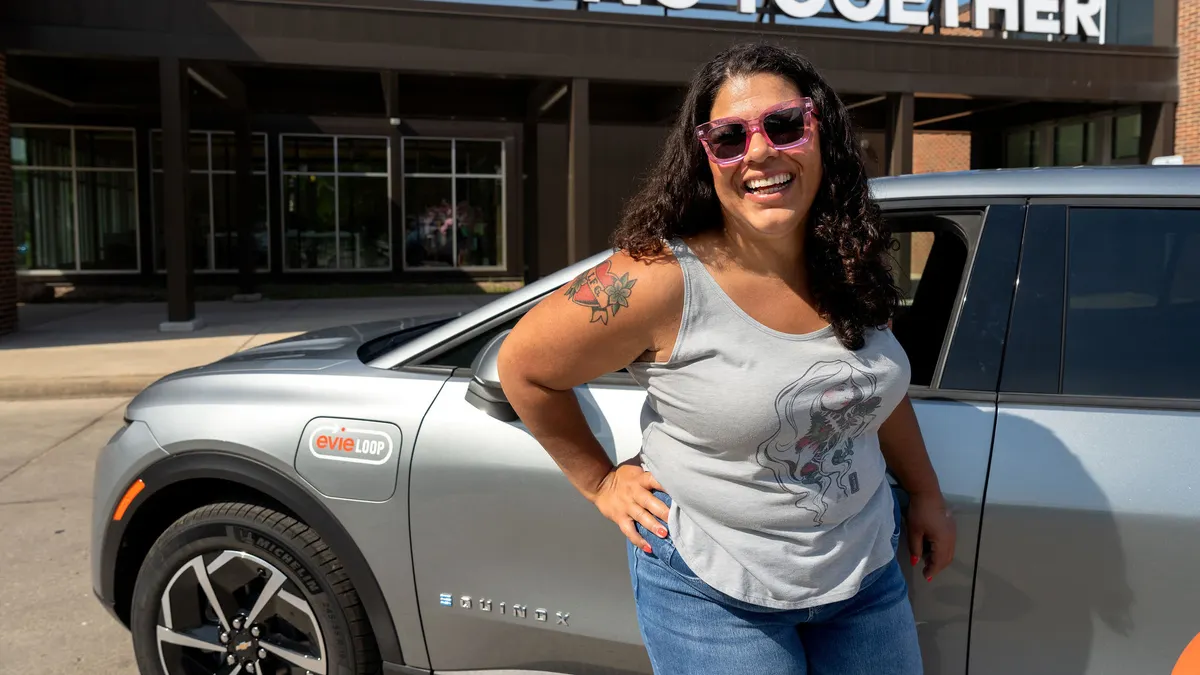
The EV Spot Network is the only municipally owned car-sharing and car-charging network in the United States, according to Amanda LaGrange, CEO of Hourcar, the nonprofit that operates the network’s vehicle fleet. That fleet consists of 168 electric vehicles that residents can pick up and drop off anywhere within a 40-mile radius.
The network also has 70 public curbside charging stations providing a total of 140 charging heads for car-sharing vehicles and another 140 for privately owned EVs, LaGrange said. The chargers operate on 100% clean energy provided by Xcel Energy, which is another of the program’s unique features, she said. In 2025, those charging stations were used for over 52,000 charging sessions, and users took 140,000 car-sharing trips, she said.
Why car-sharing? As the St. Paul EV Spot Network website puts it, “For every car-sharing vehicle available in a community, the people of that community purchase 8 to 11 fewer cars than they did before. This lowers local air pollution and greenhouse gas emissions while protecting public health and helping slow climate change.”
Even though the Twin Cities have “a really strong public transportation system, it couldn't get people everywhere that they wanted to go,“ LaGrange told Smart Cities Dive. Car-sharing “reaches places other modes can’t,” she stated in her nomination form. “It was designed to meet that need without the financial burden and environmental impact of car ownership for every household.”
Building on earlier efforts
The Twin Cities’ 2017 shared mobility action plan became the foundation of the EV Spot Network, according to LaGrange. “There's such a hunger for figuring out how to meet some of these aggressive environmental goals in the community that I think the environment was just right to bring all of this together,” she said.
Car-sharing has long been available in the region, Erin Kayser, St. Paul’s EV charging and electric carshare program coordinator, told Smart Cities Dive. “Hourcar has been operating in the Twin Cities for 20 years. They really have car-share technology down.”
The network’s integrated technology platforms “support everything from vehicle reservations and member access to fleet management, vehicle monitoring and driver safety,” LaGrange said. The EV Spot Network makes vehicles within the service area available at any time of day through the Evie/Hourcar app.
Before launching the EV Spot Network, Minneapolis and St. Paul leaders, together with Hourcar, met with residents in focus groups to understand how an expansion of car-sharing could fill unmet transportation needs, LaGrange said. Residents told them that “car ownership is too expensive” and that public transportation couldn’t get them everywhere they needed to go.
That information-sharing is ongoing, Max Gonzalez, mobility project manager for Minneapolis, told Smart Cities Dive. “There's quite a bit of feedback that actually gets shared between the cities and Hourcar about people that are living either car-free or car-light lifestyles,” he said. Residents shared that the EV Spot Network helped get them to doctor's appointments and other tasks, he said.
Car-sharing as part of public transportation
Just over 20% of Hourcar’s car-sharing users say they often use public transportation and car sharing in the same trip, LaGrange said. “That's part of how the team selected where we were putting our Hourcar hubs,” she said.
“Car-share should be considered public transit,” Kayser said. “It continues to help us get single-occupancy vehicles off the road or in limited use on the road.”
In many cases, car-sharing is either a first-mile or last-mile connection to public transportation, LaGrange said. The EV Spot Network’s electric vehicles create options for neighborhoods with the most zero-car households and those most affected by vehicle emissions, she said. “We have to think about climate resilience across a lot of different paths, and getting from point A to point B is an important one,” she said.
Public charging made an all-electric car-sharing network feasible, further reducing emissions. Public charging is especially important “in dense areas where multifamily housing doesn't always have the ability for folks to charge at home,” Kayser said. In addition to serving the car-sharing network, it “allows folks to make decisions about purchasing an electric vehicle, should that be something that's in their future,” she said.
As Gonzalez put it, “The EV car share network and curbside EV charging system allows people to test or try an electric vehicle … without having to make that full commitment on either a long-term rental or purchasing an EV.”
Residents want more
The program’s 2024 annual report, the most recent available, shows it succeeding according to several measures: Car-sharing trips, charging sessions, and emissions reductions grew in its first three years, for example. In 2024, 44% of its users were low-income, the report states; 77% said the program allowed them to sell a car or postpone buying a car.
The report also lists plans to expand service into four new service areas and add vehicles to the fleet. “We hear all the time, when is charging coming? When is car share coming?” Kayser said. Minneapolis “would love to add additional vehicles and expand the service area,” Gonzalez said.
“The intention is to continue to cover as much of Minneapolis and St. Paul and beyond as we can,” LaGrange said. That would require additional funding, Gonzalez said. Both noted the importance of the program serving both cities, as residents regularly travel between them.
Kayser’s advice to city leaders considering a similar program is to “think about who you want your partners to be … Ask a lot of questions and get the right folks in the room,” she said.
The EV Spot Network might be unique in bringing multiple cities together and being a public-private partnership, LaGrange said, but “my dream would be that a lot of cities have this type of program.”