
Dive Brief:
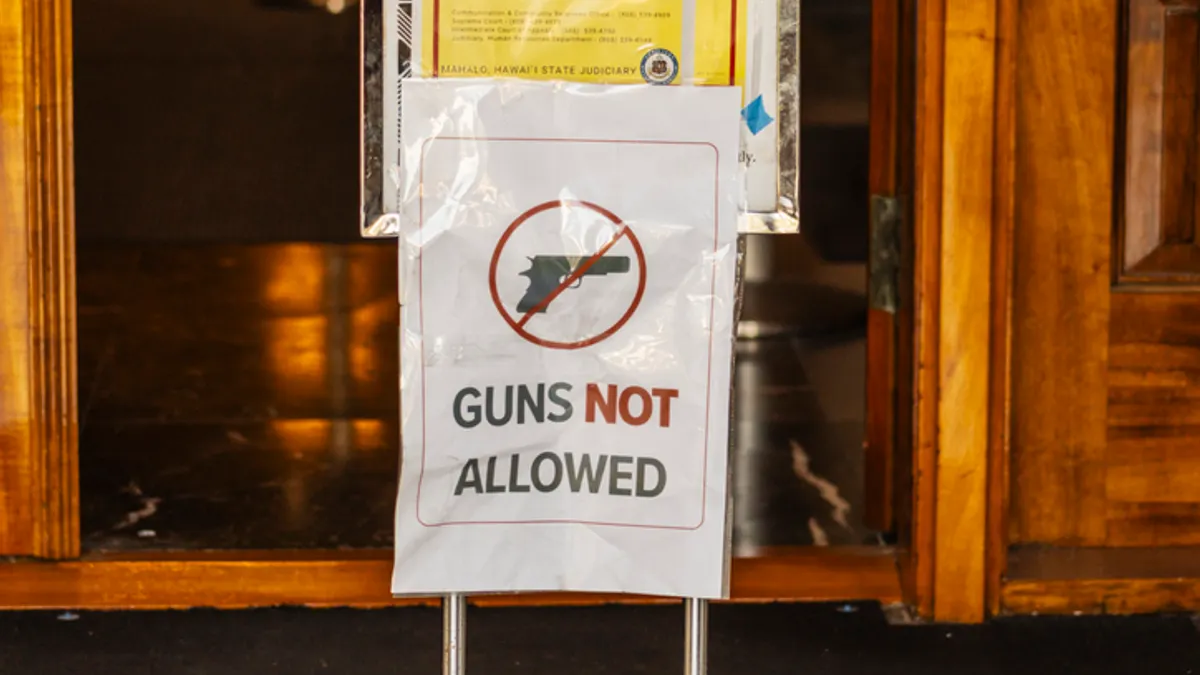
- The U.S. Supreme Court in a 6-3 decision on Thursday struck down a Hawai'i law prohibiting guns on public-facing private property unless owners say they’re permitted. As a result of the decision, owners of stores, restaurants and other types of public-facing private property that want to prohibit guns must communicate that. It’s no longer the case that guns are prohibited by default.
- The Wolford v. Lopez decision applies to Hawai'i, but it puts at risk similar laws in other states, including California, Maryland and New Jersey.
- The decision follows a federal appeals court decision in May that struck down a similar law in New York. The Supreme Court action makes it less likely New York will look to the top court to reverse the appeals court decision.
Dive Insight:
Hawai'i is one of several states that enacted so-called vampire rules after the Supreme Court in 2022 shot down New York’s concealed carry ban in N.Y. State Rifle & Pistol Association v. Bruen.
In folklore, a vampire can’t enter a home without the owner’s permission. Under the state laws that were passed, a person carrying a gun can’t enter a public-facing private property without the owner’s permission.
In writing the majority opinion for the court, Associate Justice Samuel Alito said the issue isn’t property owners’ right to keep guns off their property if they want; they have that as a property right under common law. The issue instead is making property owners choose between allowing guns, if that’s their preference, and risking the loss of business of people who oppose that by having to post a sign or otherwise communicate that guns are permitted.
“Proprietors who do not object to entry by carry-permit holders may be reluctant to post welcoming signs for fear of alienating customers,” Alito wrote. “A proprietor in this category may only be willing to consent discreetly to the entry of permit holders who make the effort to inquire. This arrangement imposes a new burden on permit holders who will have to somehow obtain permission to carry a firearm on the property before stepping foot on it.”
In striking down Hawai'i’s law, the court said the state failed to show the restriction aligns with historical laws that form a national tradition of firearms regulation. All of the laws that the state held up as examples of a historical tradition of banning guns on private property missed the mark, the court said. Either they applied only to property access for purposes of hunting or they were intended to restrict gun possession by a certain subset of the population.
It also doesn’t matter that Hawai'i has a history of restricting gun possession that dates back before it was a state, because the constitutional right to bear arms applies equally across all states regardless of their traditions, the ruling stated. “The Second Amendment cannot give way to ‘the spirit of Aloha’ in Hawaii,” Alito wrote.
In a statement, Adam Kraut, executive director of the Second Amendment Foundation, said the decision properly puts the onus on property owners to communicate what their policy is.
“If a business does not want you to carry a firearm on the premises, the burden should be on the proprietor, not the private citizen,” Kraut said. That’s no different than the “‘no soliciting’ … signs we’re all familiar with.”