Before the U.S. Department of Homeland Security announced earlier this month that it was providing electric shock gloves to Immigration and Customs Enforcement agents, the technology known as Generated Low Output Voltage Emitter — or GLOVE — was relatively obscure. Very few municipal law enforcement agencies use the gloves, Seth Stoughton, a professor at the University of South Carolina School of Law, affiliate professor in the university’s Department of Criminology and Criminal Justice and faculty director of the Excellence in Policing and Public Safety Program, told Smart Cities Dive.
Stoughton, a former officer with the Tallahassee, Florida, police department, outlined why the gloves aren’t commonly used in street policing and the questions municipal agencies should ask before buying them.
Editor’s note: The following interview has been edited for length and clarity.
SMART CITIES DIVE: Is this a technology municipal police departments are interested in?
SETH STOUGHTON: I'm actually not aware of any police agencies that issue these gloves. The only agencies that I'm aware of that use them are sheriff's offices that run jails or other correctional facilities. The gloves inevitably involve a lot of limitations and raise a lot of potential questions about their use in police interactions.
What are the drawbacks for street policing?

It's most natural to compare this glove with a Taser. It is a type of what police call a CEW, a conductive electrical weapon, or an ECD, an electronic control device. There are a couple of different names, but the basic idea is it uses electricity to inflict pain. Tasers, as the leading ECD, are generally considered, and in many places legally considered, to be appropriate for use only when officers are defending themselves or someone else against a physical threat. So, if someone is resisting in a way that does not actually physically threaten the officers — let's say someone is curled up in a ball and refusing to get up, or they're running away, or they're trying to hide their hands but they're not reaching for a weapon or attacking officers — it's inappropriate in street policing to use a Taser.
If the subject is trying to punch or kick an officer, or they're doing something that creates a threat of physical safety to the officer or to someone else, it becomes appropriate to use a Taser, but typically you want some distance between you and the person who is trying to punch you or kick you. A glove is obviously a melee-range weapon. If I can't touch them with my hand, I can't use this glove effectively.
Could it hinder police operations?
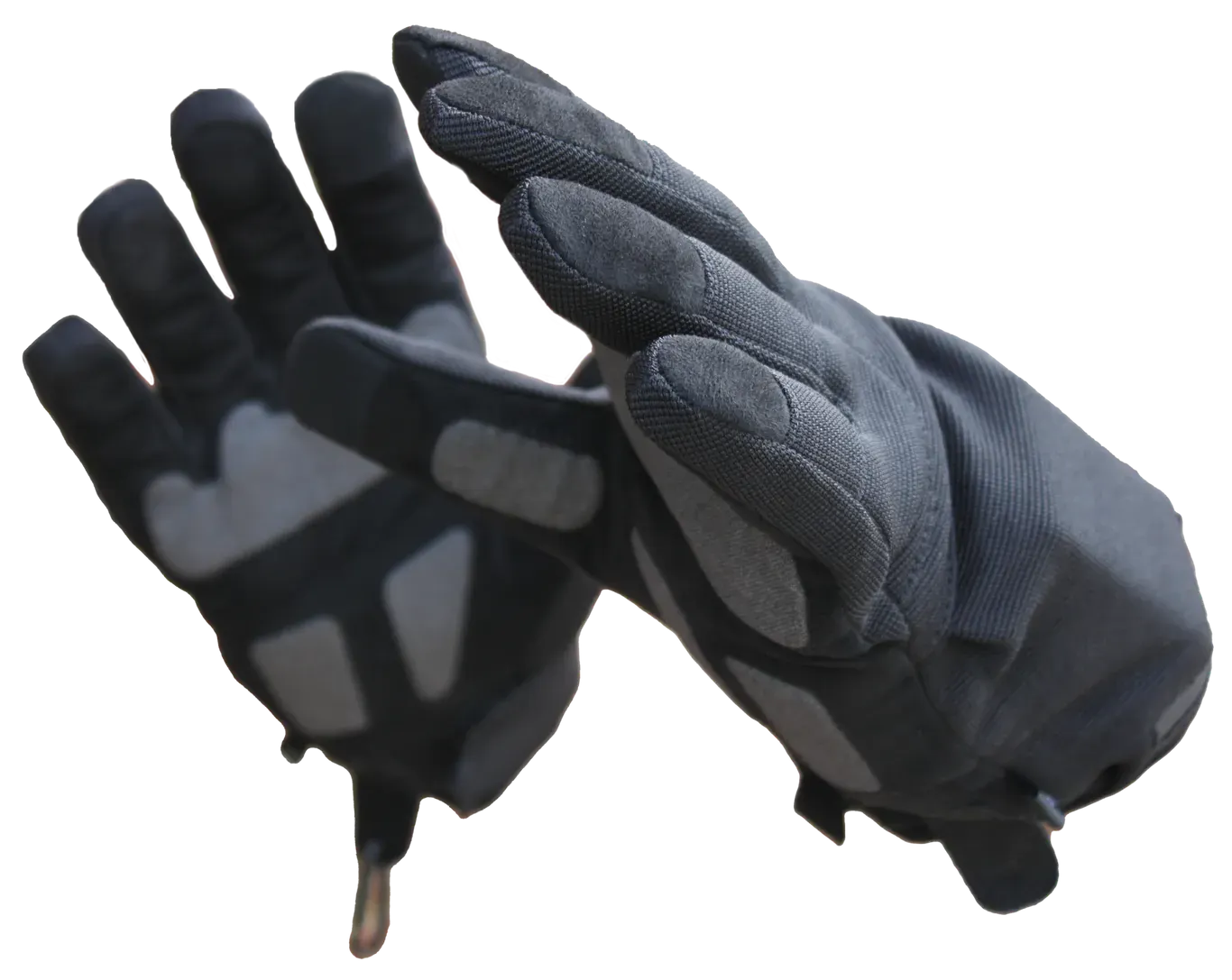
In most contexts in street policing, the officer is going to want to remain engaged with the person, and if they continue to hold them or touch them with the glove, they're going to continue to shock them, which is not okay because at this point the person is compliant. Or they're going to have to take the glove off, and you don't want it sitting out somewhere where the guy you're struggling with can get a hold of it, and you don't really want to take the three seconds that it takes to turn it off because that's tying up both hands for three seconds. Three seconds could be a long time.
Also, when officers are working in teams, they often intentionally, unintentionally, sometimes inadvertently, sometimes absent-mindedly, touch each other. I put my hand on another officer's back, or I pass the suspect's hand over to this officer to handcuff him, and in doing so, I'm going to be making contact with my fellow officer's hand.
So, you don't see the recent headlines about ICE using the gloves sparking interest among municipal agencies?
I don't think it makes a whole lot of sense. I think a lot of police agencies have probably come to the same general conclusion and may be thinking this doesn't really complement or provide a lot of added benefit beyond their current force options. But agencies certainly respond to what other agencies are doing, and there is a little bit of a contagious effect. When one agency gets a new toy, at least some other agencies might also think, oh, maybe we should look into that too. So, I wouldn't say there's going to be no increase, but I don't predict this becoming the next Taser.
How should police departments evaluate new technologies like this one?
I run a program that trains police executives. What we do is say, “Okay, so this is a framework, a series of questions that you can ask to figure out whether any given piece of technology makes sense for you and your local needs.” And the first question is, what problem is this piece of technology trying to solve? What are you trying to do? What's the goal? The second question is, what are the capabilities and limitations of the technology in solving that goal? The third question is, now that I understand the capabilities of the device itself, what are the capabilities, challenges and limitations of people as we use this thing? The fourth question becomes more comparative: Given the problem that we're trying to solve, and given the potential and the challenge of this particular technology, is this an efficient way to solve this problem? Are there other better, different ways, maybe cheaper ways, maybe more effective ways?
What we're doing is a cost-benefit analysis. What are the practical benefits likely to be? And then, how costly is it going to be? How much does the actual equipment cost? How much training time are our officers going to need? What kind of maintenance are we going to need for this equipment? Then we can ask the ultimate question: Are the practical benefits worth the anticipated costs? And at least for me, when I see the GLOVE and I'm applying it in the context of street policing, I think the benefits are very limited.