Dive Brief:
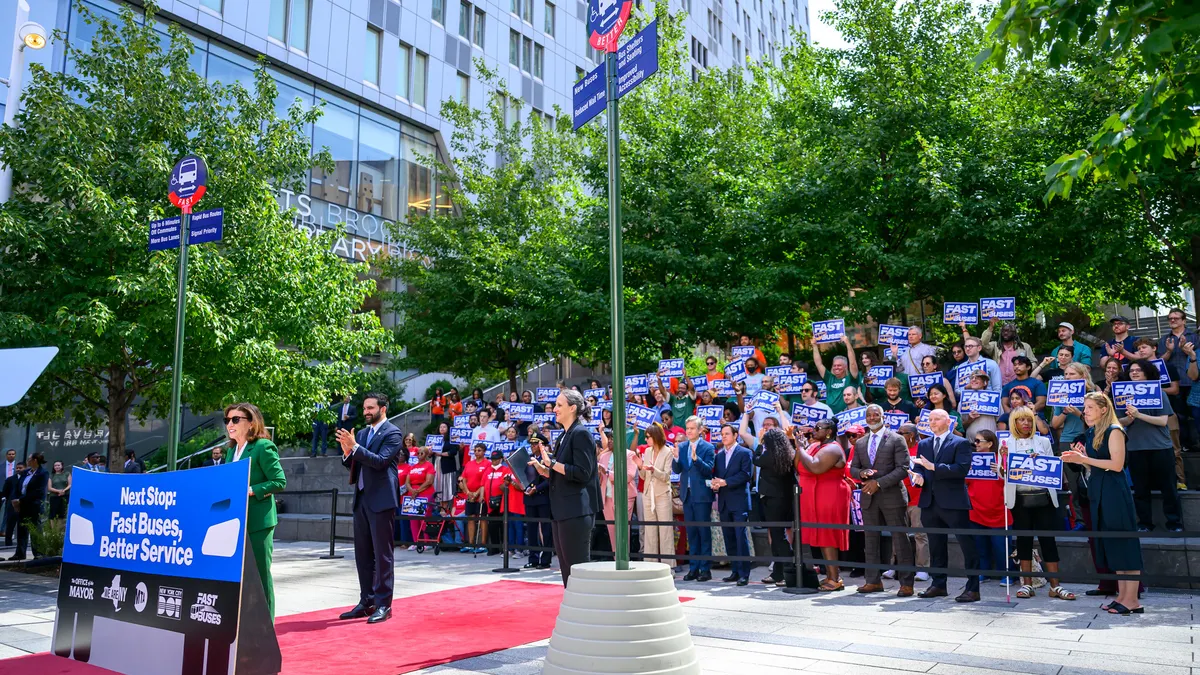
- New York state and New York City leaders agreed on a plan to improve travel times for bus riders on 50 corridors across all five boroughs, according to a July 8 press release.
- The program calls for automated bus lane enforcement cameras to be mounted on city buses along 25 routes, in addition to 67 routes as of July 8. An additional 200 roadside cameras will be installed targeting vehicles driving illegally in marked bus lanes. The New York City Police Department will also increase its bus lane enforcement from 14 to 20 corridors beginning this year.
- Separately, the New York City Council and Mayor Zohran Mamdani agreed to expand the city's reduced-fare program to 340,000 additional low-income residents, bringing total eligibility to some 1.3 million people. The June 30, 2027, fiscal year budget proposal includes half-price subway, bus and paratransit fares.
Dive Insight:
The two agreements follow a long period of efforts to improve bus service and make public transit affordable to more people in New York City.
“For years, we at MTA have wanted more bus lanes, more enforcement of cars and trucks blocking bus lanes …. But it’s no secret we didn’t have support at the local level,” New York Metropolitan Transportation Authority Chair and CEO Janno Lieber said in a statement. “That is not the case anymore.”
New York City buses make 2.75 million passenger trips daily at an average speed of 8 mph, according to the news release.
Five corridors in the boroughs of Brooklyn, Queens and the Bronx were selected as the first new fast routes. Starting this year, the MTA and the New York City Department of Transportation will install protected bus lanes, upgrade bus stations and provide frequent all-day service.
“For too long, bus riders have endured unbearably slow, unreliable trips, due in part to politics, but that’s about to change,” Permanent Citizens Advisory Committee to the MTA Executive Director Lisa Daglian said in a statement.
The MTA and NYC DOT said they will install 300 new bus shelters by 2028, add seating at 875 bus stops each year until “every feasible stop” has seating by 2035 and increase the number of real-time passenger information displays to 2,900 citywide by 2030, according to the news release.
“These improvements are long overdue and can’t come soon enough for New Yorkers who depend on buses every day,” Regional Plan Association Executive Director Kate Slevin said in a statement.
The state and city agreement also aims to improve accessibility by upgrading bus stops with benches, leaning bars, shade trees and shelters. The Center for Independence of the Disabled, New York, Executive Director Sharon McLennon Wier said in a statement that it supports “equitable bus expansion,” but warns that “fast bus service cannot take for granted safe and accessible transit for all.”
The MTA’s 2025-2029 capital investment program includes buying some 2,500 new buses, replacing about 40% of its fleet.