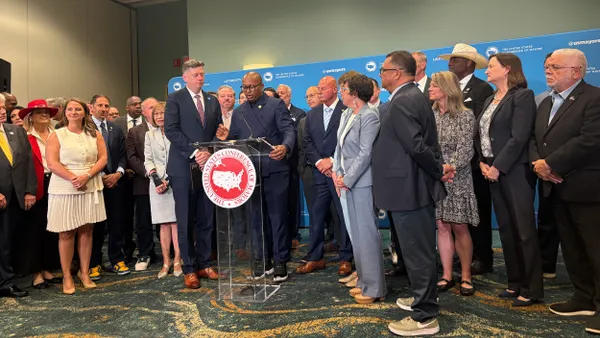



State and county financial leaders are calling for more federal support in tackling the rising cost of housing.
Amid a backdrop of rising cost burdens for renters and homeowners in the U.S., public sector financial leaders from Alabama, Arizona, Illinois and Minnesota spoke out about the impact of Trump administration tariffs on housing costs as well as proposed cuts to federal housing programs during a virtual press conference Tuesday. The event was organized by For the Long Term, a nonprofit for state and municipal financial leaders.
“County treasurers are on the front lines, and we hear these struggles every day,” Coconino County, Arizona, Treasurer Sarah Benatar said. Half of the county’s renters are cost-burdened — spending more than 30% of their income on housing — and the county is short more than 2,600 homes, she said.
“We know our communities, and we're ready to build,” Benatar said. “We just need a federal partner willing to build with us.”
In March, President Donald Trump issued an executive order to begin cutting federal regulatory barriers to affordable housing development, resulting in a “best practices” guide for local governments from the U.S. Department of Housing and Urban Development on reducing homebuilding red tape. Federal agencies have begun making changes to environmental permitting requirements since the order, Reason reported.
The Trump administration has also proposed cutting key affordable housing and homelessness assistance programs for local governments from HUD, including the $3.3 billion Community Development Block Grant and $1.3 billion HOME Investment Partnerships Program.
The lowest-income renters are feeling the housing crisis the most in Minnesota, State Auditor Julie Blaha said. The state still needs 97,500 more affordable housing units to meet demand from Minnesota’s 166,500 lowest-income renter households.
Reducing zoning and building code regulations at the local level can make an impact, but the crisis demands more action at a higher level, Blaha said.
“We cannot deregulate our way out of this crisis,” she said. “We need strong federal partners that keep their promises, and we need general affordability … We need to stop these arbitrary tariffs that are driving up the costs of everything. We've got to get diesel [costs] down. Everything that's building a house runs on diesel.”
Tariffs on steel, lumber and aluminum are adding thousands of dollars to the cost of housing construction, Illinois State Treasurer Mike Frerichs said. “Illinois is already more than 140,000 homes short, and the Trump administration wants to cut the very programs that help build affordable housing.”
Jefferson County, Alabama, Treasurer Angela Webb-Weinberg said she works regularly with banks to make sure the county’s financial investments are returning to the community. She also hosts educational sessions on financial literacy and money management to help county residents prepare for homeownership.
“Our financial literacy work helps residents prepare for tomorrow, but we have to ask, what happens when a family budgets carefully, saves consistently, works hard and still cannot afford a home,” Webb-Weinberg said. “The question challenges us to examine the policies, investments and partnerships that shape our opportunity.”
Benatar urged Trump to listen to the growing concerns among local leaders and financial experts.
“Talk to your counties,” she said. “We have a lot of information. We are the closest thing to the people, so listen to us and take the time to understand what these impacts are truly doing.”
“Every number is a person, and behind every person is a child,” Webb-Weinberg said. “And understand that families are suffering right now, and we need help.”