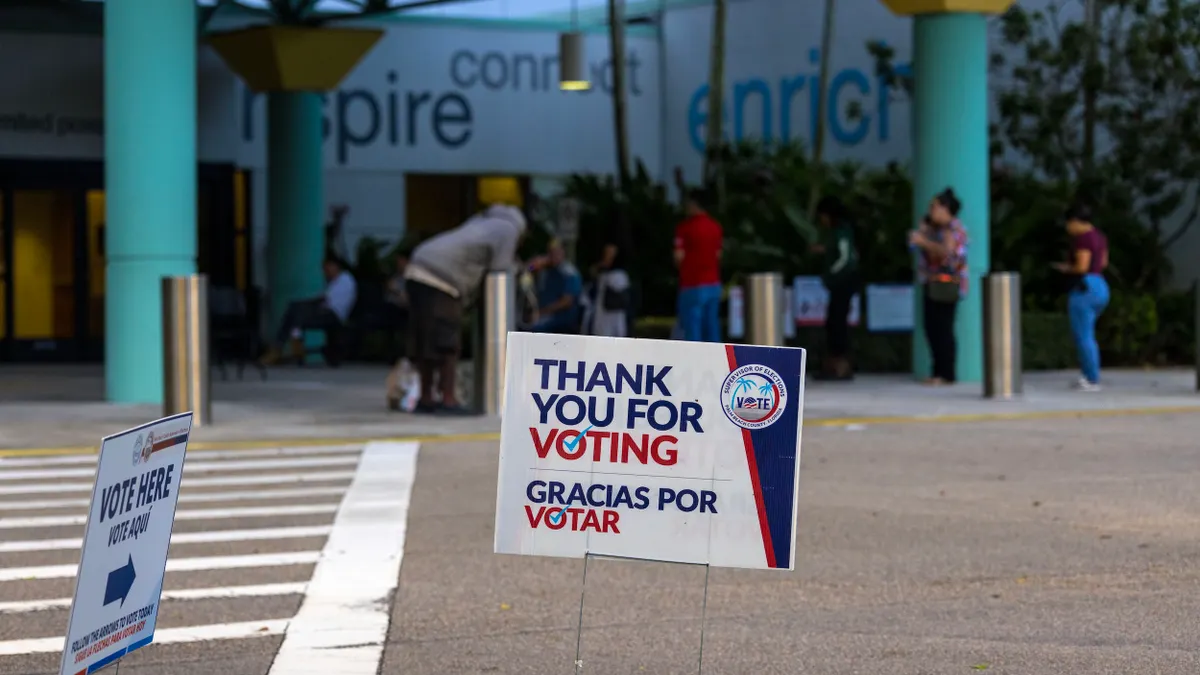
Voters in 15 states weighed in on referendums addressing tax policy and government spending on their midterm ballots, according to a new S&P Global Ratings report. The results could “signal a shift toward additional narrowing of fiscal flexibility” and potentially affect future credit ratings for municipalities, the report states.
With the exception of an amendment restructuring Florida’s tax base and a graduated income tax in Colorado, voters mostly rejected sweeping tax changes, according to the Tax Foundation. While Californians rejected a proposed wealth tax, voters in Washington defended a new income tax on income above $1 million.
The Nov. 3 referendums primarily fell into two categories: limiting tax hikes on everything from groceries to housing or approving revenue increases for narrowly defined priorities like transportation or healthcare, according to the S&P report.
While these categories may appear to be conflicting, “there’s a central theme here on affordability and accountability,” Jane Ridley, S&P Global managing director and sector lead for U.S. public finance, local governments, told Smart Cities Dive.
Revenue-restriction and tax-limiting referendums affect “future government autonomy and self-direction by generating less revenue or limiting revenue growth for future expenditures,” the report states. At the same time, revenue-expansion and dedicated-funding referendums aren’t designed for “providing governments with autonomy for allocation,” but rather to “earmark funds for specific purposes,” according to the report.
In the limiting tax hikes category, the report singled out Florida’s Amendment 3, which constrains taxable property values and reduces city and county revenues. The amendment passed with 62% of the vote. “The full impact of Amendment 3 will take several years to manifest, but issuers with weaker credit quality that are already struggling to maintain budgetary balance might feel this pressure sooner,” the report states.
In the revenue-increases category, the report highlights California’s Proposition RTM, which boosts retail sales and use taxes by 0.5% for 14 years in Alameda, Contra Costa, San Mateo and Santa Clara counties, and 1% in San Francisco city and county, to fund Bay Area mass transit.
The proposition passed with 61.5% of the vote, which shows that “people are willing to pay up when they have something tangible, particularly for transportation,” Kurt Forsgren, S&P Global managing director and sector lead for U.S. public finance, transportation, told Smart Cities Dive.
Whether these and the other midterm referendums are a bellwether for municipal governments remains to be seen, Ridley said.
“Governments are very good at figuring out how to make things work. We’re just watching and waiting to see what happens and how it gets absorbed,” she said. “If you start to restrict revenues in different ways without a backfill on revenues, that’s something where we’re going to say, ‘How are you going to remain balanced?’”