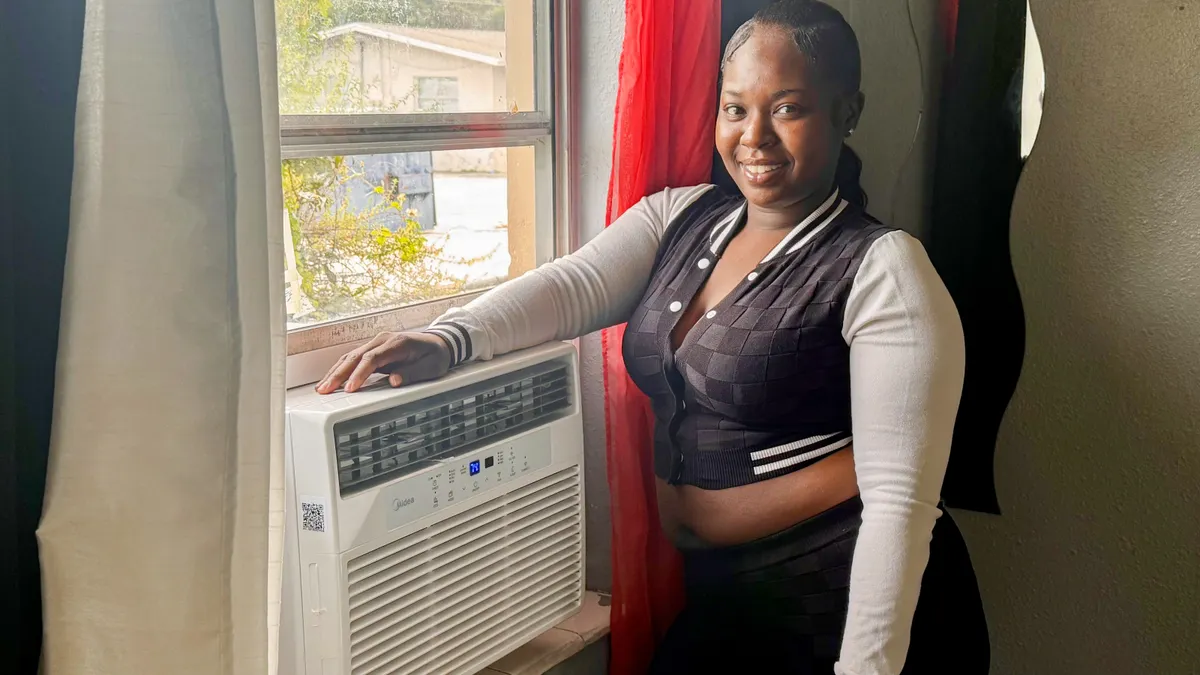
A mother and her three children sleeping in their only air-conditioned room. A mom of six who couldn’t afford to fix her central air. A couple who relied on processed and microwavable food because they hadn’t had a working stovetop in more than 15 years.
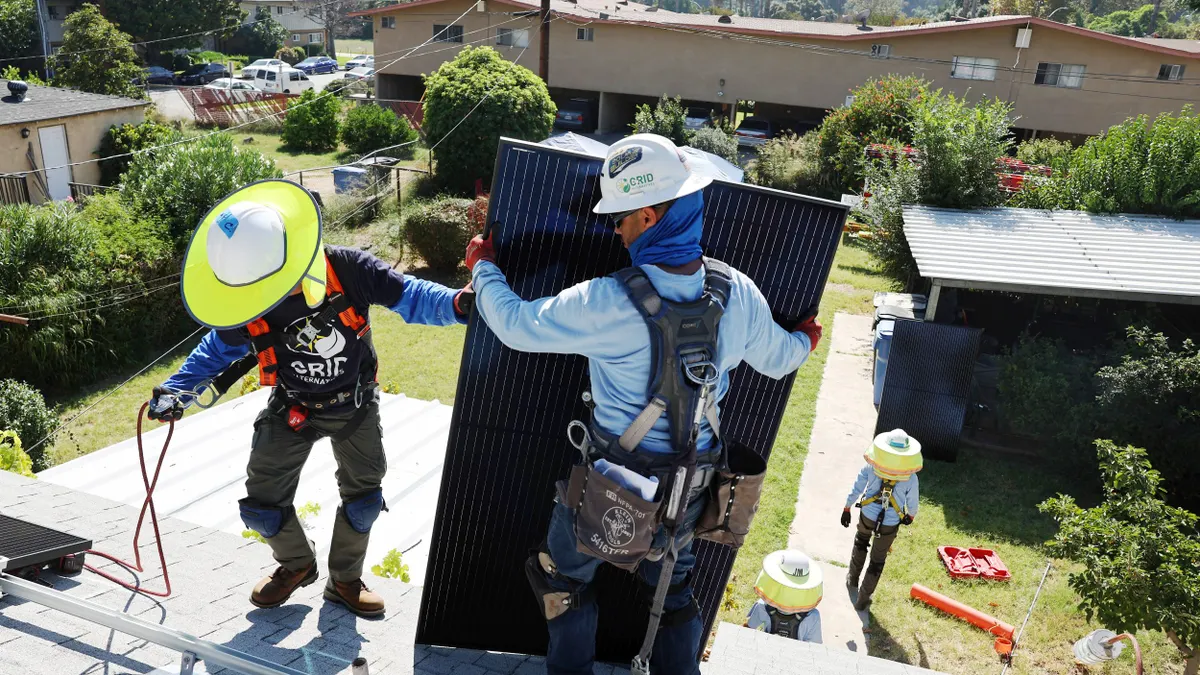
These are the people Orlando, Florida’s Energy Savings Program helps by providing free heat pump plug-in air conditioners, heat pump water heaters, portable solar panels and batteries, and induction cooktops, said Mike Taylor, sustainability initiatives manager in the city’s Office of Sustainability & Resilience. The program, launched in 2024, helps Orlando’s low-income residents, who spend 130% more of their monthly income on energy bills than the national average. Because 62% of Orlando residents are renters, he said, “we wanted to create something that they could utilize, too.”
So far, the Energy Savings Program — a 2026 Smart Cities Dive Community Project Award winner — has provided energy-saving devices to 95 households, said Ashley Perez, the city’s sustainability project manager. Program participants also get baskets stocked with energy-efficient items such as LED bulbs, weatherstripping, low-flow plumbing fixtures and even glow-in-the-dark star stickers to encourage youngsters to turn lights off.
Participants save, on average, $16 on their energy bills each month, Taylor said. The target savings is $10, an amount that can help cover grocery and medical bills, added Anna Ashie, director of housing operations at the Homeless Services Network of Central Florida, a program partner.
“The savings for the residents actually equate to ending homelessness,” Ashie said. “What happens is you’re $10 short [on rent], so you get a $50 or $100 late fee, and then every day, late fees can be added on. … By the time the next month rolls around, you’re a couple hundred dollars in the hole.”
One resident who lives on $700 a month saw both his electric and water bills decrease after receiving a solar panel, she said. He’d been taking several cold showers a day to keep cool.
“It was really cool to see that not only was he feeling the financial savings, but he told us that he felt connected to the future,” Ashie said. “He felt connected to the community because he had been invited to participate in this project, and it made him feel a sense of dignity and inclusion that he had not otherwise felt.”
Small fixes, big impact
The Office of Sustainability learned about low-income residents’ energy-saving needs in 2023 through community workshops, resident outreach and the Energy Burden Task Force, an intergovernmental group created to explore innovative retrofit models to accelerate energy equity, avoid displacement, and creatively address the split incentive between landlords and tenants, among other things. Feedback revealed that many energy cost rebates benefit homeowners, but not renters. That’s important, Taylor said, because in some lower-income areas, 91% of the population rents.
The Energy Savings Program partnered with HSN, solar solutions provider 15 Lightyears, Poder Latinx, the Desire Foundation, Grassroots Impact and others to provide energy-saving technology that residents could take with them if they moved. Residents’ existing relationships with those organizations helped build trust in the effort, Perez said.
“The main question I get is, ‘Is this free? What’s the catch?’” she said.
“We’re allowing them to be vulnerable and welcome us into their homes,” Taylor added. “It may not be something that’s really comfortable for them.”
3-phase program
For the project’s first phase, city funds helped four households with a goal of cutting $10 from each electric bill, Perez said.
Phase Two began when the city received a donation of 50 window air-conditioning units from the 4Roots Foundation, an Orlando-based nonprofit, she said.
Phase Three is underway. With a $115,000 Partners for Places grant from The Funders Network, Orlando has helped another 41 households, Perez said. The city also secured a one-year extension on a federal Energy Efficiency and Conservation Block Grant, effectively funding the program through June 2027, Taylor added.
“We actually have another grant that we’re in the process of applying for now,” Taylor said. “My fingers are crossed that we will be awarded that and that we will able to make even more progress.”
How it works
Orlando residents and landlords of Orlando properties can apply online to get one of the four devices. Renters need written permission from their landlord to participate in the program.
“Even though we were targeting renters, there are also some homeowners who are on fixed incomes — they’re seniors, they're elderly, they're disabled — and they're not able to pay hundreds of dollars for a new water heater,” Ashie said.
Taylor and Perez review the applications, then they conduct phone interviews with the applicants and perform a home walk-through.
“We make sure that a water heater is going to work for them … or if we are going to do solar, we really want to make sure that they’ve got a clear, sunny location to put the panels out,” Taylor said. “We want to make sure that we are not giving them something that’s not going to work for them.”
The time between application and installation varies, but it can be as quick as a week and a half, Taylor said.
In total, the program has received 150 applications, Perez said. Some were rejected because applicants live outside city limits or didn’t respond to the phone screening.
Building community
The team advertises the energy-savings program in communities with known need, but word-of-mouth is its best marketing tool.
Meroy Charles-Hudson, a beneficiary of the program, invited Perez to speak at her church about it last fall. “I wanted all of the seniors to be aware of the programs that are available in the city,” she said. “They’re just not able to afford some things that break down in the house.”
She also connected one of her brothers to the program. “My brother stays in the house that my parents built. I think we moved over there in 1957,” she said. “I happened to be over there nosing around, and I’m like, ‘You need another water heater.’”
Ultimately, both siblings got water heaters and solar panels. Charles-Hudson now plans to connect people she knows who need air conditioners with the program.
That sense of community among recipients has been a happy byproduct of the program, said Isabella Vivino, sustainability communications coordinator for the city of Orlando.
“We’re doing a lot of community workshops right now, and a lot of the residents who were part of the program have come out to workshops as their way of supporting us back, which just really shows trust in government,” Vivino said. “People [want] to help other people get the same benefits they got.”
For Taylor, decreasing power bills is great, but improving city-resident relations is the real measure of the program’s success. “You can’t really quantify that,” he said.